
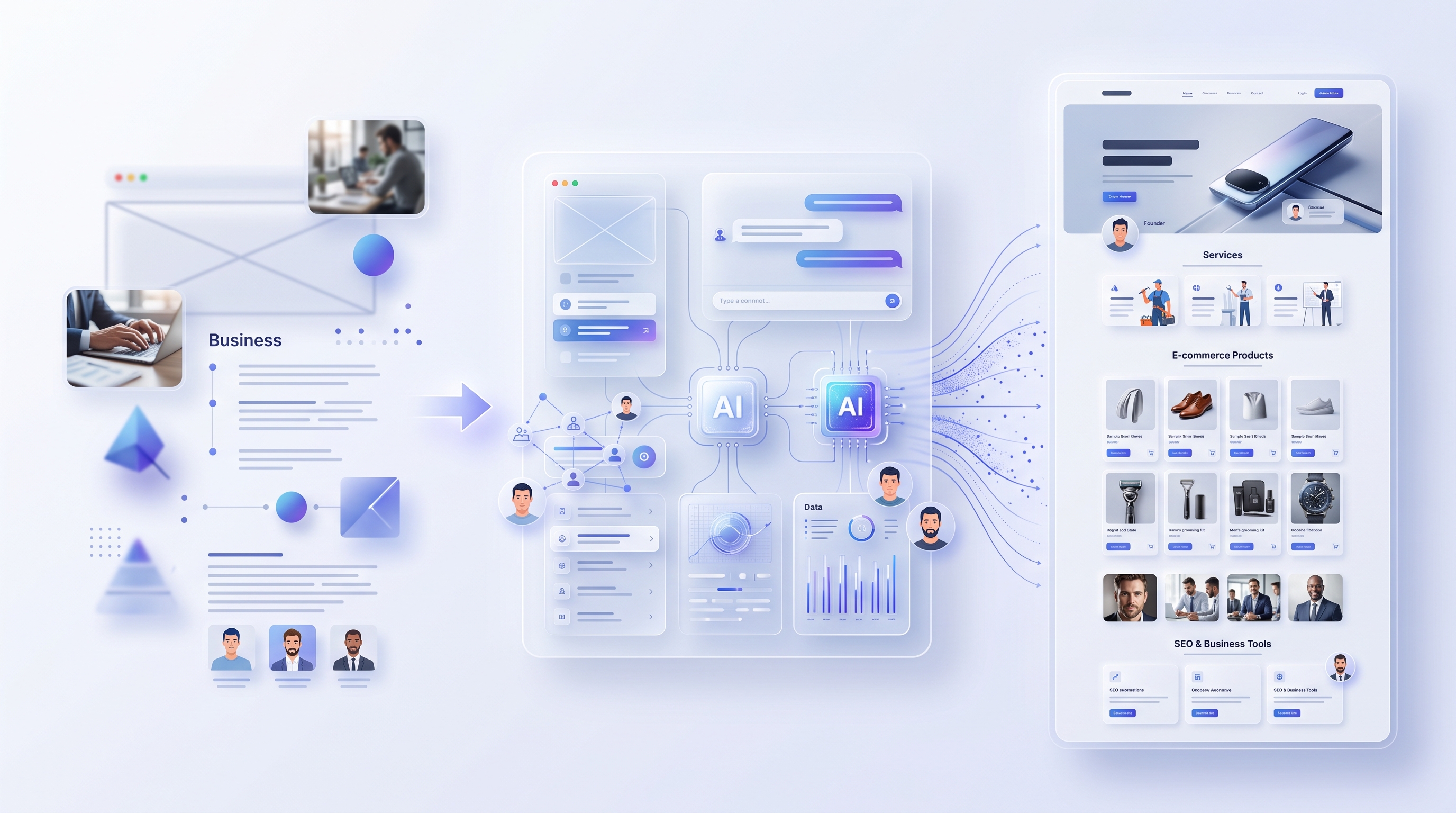
AI Website Builders Have Changed
For many years, creating a professional website followed a familiar process. A business owner would choose a template, customize the colors and layout, write the website content, upload images, install plugins, configure settings, test the website, and finally publish it.
That process worked, but it often required a combination of design knowledge, technical knowledge, content-writing skills, SEO knowledge, and time.
In 2026, the website-building process is changing significantly.
AI website builders are moving beyond simple template customization. Modern platforms are increasingly capable of understanding business information, generating website structures, assisting with content, helping with SEO, supporting ecommerce, and allowing users to make changes through natural-language instructions.
The biggest change is not simply that AI can generate a webpage.
The bigger change is that AI is becoming part of the entire website lifecycle — from the initial idea and content creation to design, editing, optimization, business functionality, and ongoing management.
This shift is changing what people expect from a website builder and how businesses think about launching their online presence.
1. From Templates to AI-Generated Websites
Traditional website builders usually begin with a template.
A user selects a design based on their industry, such as a restaurant, portfolio, agency, ecommerce store, consulting company, or local business. After selecting the template, the user replaces the sample text, images, colors, fonts, and sections with their own information.
This approach gives users control, but it also requires them to make many decisions before the website starts to look professional.
AI-powered website builders are changing this starting point.
Instead of beginning with a template, users can increasingly begin with information about their business.
For example, a business owner might provide:
- Business name
- Business description
- Services
- Products
- Pricing
- Contact information
- Business location
- Brand preferences
- Existing documents
- Images
- Social media information
The AI can then use this information to create an initial website structure.
“Create a professional website for my digital marketing agency. Include our services, pricing, portfolio, testimonials, contact information, and a modern design.”
A request like this represents a major shift in how websites are created.
Instead of thinking about individual sections first, users can describe the outcome they want and allow AI to translate that requirement into a website.
2. AI Can Understand Business Context
One of the most important developments in AI website building is the ability to work with business context.
A website should not simply look attractive. It should communicate what a business does, who it serves, what it offers, and how customers can interact with it.
AI can help transform business information into website content and structure.
For example, imagine a restaurant provides its menu, location, opening hours, contact details, and a short description of its brand.
Instead of manually creating every section, an AI-powered platform can potentially organize that information into sections such as:
- Hero section
- About the restaurant
- Featured dishes
- Full menu
- Customer reviews
- Opening hours
- Location
- Contact section
- Reservation or ordering functionality
This means the AI is not only generating visual elements. It is helping translate business information into a digital experience.
3. Conversational Website Editing
Another major change is the way users interact with their websites.
Traditional website builders require users to navigate through menus, settings, panels, blocks, and design controls.
AI-powered platforms are introducing another approach: conversational editing.
Instead of manually searching for a specific setting, users can describe what they want to change.
For example:
- “Make the hero section more modern.”
- “Add a testimonials section below the services.”
- “Move the pricing section above the FAQ.”
- “Make the website more mobile-friendly.”
- “Change the design to look more premium.”
- “Add a contact form to the bottom of the page.”
- “Make the buttons more noticeable.”
- “Rewrite this section in a more professional tone.”
The AI can interpret the instruction and apply the requested changes.
This interaction model is important because it changes website editing from a technical activity into a communication activity.
Users do not necessarily need to know the exact setting or component they need to modify. They can describe the desired result.
4. Website Creation Is Becoming More Accessible
Historically, professional website creation required different skills.
A business owner might need a designer for visual design, a developer for implementation, a content writer for website copy, and an SEO specialist for search optimization.
AI website builders are bringing some of these capabilities together.
This does not mean that every business can completely replace professionals with AI. Complex projects still require expertise.
However, AI can significantly reduce the barrier to getting started.
A freelancer can create a portfolio faster.
A startup can create an initial landing page without building everything from scratch.
A local business can establish an online presence with less technical knowledge.
A developer can use AI to accelerate repetitive implementation work.
As a result, website creation is becoming accessible to a much wider group of users.
5. AI Is Moving Beyond Design
One of the biggest misconceptions about AI website builders is that their primary purpose is simply generating attractive designs.
Modern AI website platforms are increasingly expanding beyond visual design.
AI can assist with areas such as:
- Website content
- SEO metadata
- Product descriptions
- Landing pages
- Forms
- Customer communication
- Product organization
- Ecommerce experiences
- Business workflows
- Marketing content
- Website personalization
- AI assistants
This changes the role of the website.
Instead of being only a collection of static pages, a website can become a digital business platform.
6. AI-Assisted Content Creation
Creating website content can be one of the most time-consuming parts of launching a website.
A business may have a clear idea about its services but struggle to turn that information into professional website copy.
AI can help transform basic information into structured content.
For example, a user might provide:
“We provide affordable home cleaning services in Dhaka. We offer regular cleaning, deep cleaning, office cleaning, and move-in cleaning.”
AI can help transform that basic description into structured sections such as service descriptions, headlines, calls to action, FAQs, and other website content.
AI can also help adapt content for different purposes.
- Short website descriptions
- Detailed service pages
- Product descriptions
- Blog articles
- FAQs
- Marketing messages
- Meta descriptions
- Call-to-action text
Human review remains important, especially when accuracy, brand voice, and business-specific information matter.
7. SEO Is Becoming Part of the AI Workflow
Creating a website is only the beginning.
A business also needs people to discover the website.
Search engine optimization has traditionally required users to understand keywords, metadata, headings, content structure, internal linking, technical SEO, and many other concepts.
AI-powered website platforms are increasingly helping users with these tasks.
AI can assist with:
- SEO titles
- Meta descriptions
- Content structure
- Page headings
- Keyword-related content ideas
- Blog topics
- Product descriptions
- Search-friendly page content
Some platforms can also help identify areas where content could be improved.
However, AI does not make SEO automatic.
Good SEO still depends on useful information, accuracy, originality, website quality, technical performance, search intent, and a positive user experience.
Generating hundreds of pages with AI does not automatically guarantee search visibility.
The goal should be to use AI to create better and more useful experiences rather than simply creating more content.
8. The Relationship Between AI and Search Is Changing
Search behavior itself is also evolving.
People increasingly interact with AI systems to discover information, compare products, ask questions, and explore businesses.
This creates a broader challenge for website owners.
Businesses need to think not only about how their websites appear in traditional search results but also about how clearly their information can be understood by modern search and AI systems.
Clear content, structured information, accurate business details, strong user experience, and useful pages remain important foundations.
This means the future of website optimization may involve a combination of traditional SEO and optimization for AI-driven discovery.
9. Ecommerce Is Becoming More AI-Powered
Ecommerce is another area where AI website builders are expanding.
Creating an online store traditionally requires setting up products, categories, product pages, shopping carts, checkout systems, payment methods, inventory management, order management, and customer communication.
AI can help reduce the amount of manual work involved in preparing these experiences.
For example, businesses can provide product information and use AI-assisted tools to help organize and present that information.
AI can assist with:
- Product descriptions
- Product categorization
- Storefront content
- Marketing copy
- Product recommendations
- Customer communication
- Shopping experiences
When combined with ecommerce infrastructure, these capabilities can make it easier for smaller businesses to establish online stores.
10. AI and Personalized Shopping Experiences
Modern ecommerce is also moving toward more personalized experiences.
Instead of showing exactly the same experience to every visitor, websites can increasingly use data and AI-assisted systems to help customers discover relevant products.
Examples can include:
- Product recommendations
- Related products
- Personalized search
- AI shopping assistants
- Product comparison assistance
- Review analysis
- Conversational product discovery
These capabilities can help customers find products more efficiently while giving businesses additional ways to support the purchasing journey.
11. Websites Are Becoming Business Platforms
Perhaps the biggest change in 2026 is that an AI website builder is no longer necessarily just a website builder.
A modern business website may include many different functions.
- Online stores
- Appointment booking
- Contact forms
- Customer communication
- Reviews
- Events
- SEO tools
- Product catalogs
- Marketing tools
- AI assistants
- Newsletters
- Coupons
- Customer management
This creates a shift from website as a digital brochure to website as a business platform.
For many businesses, the website can become the central place where customers discover products, contact the company, book services, read information, make purchases, and interact with the brand.
12. The Rise of AI Business Assistants
Another important development is the integration of AI assistants directly into websites.
Traditional websites often rely on static FAQs and contact forms.
AI assistants can provide a more conversational experience.
A visitor might ask:
“Which service is best for a small business?”
Or:
“Which product should I choose if I have a budget of $100?”
An AI assistant can potentially use available business information to guide the visitor.
This creates a new interaction model between businesses and customers.
13. Developers Are Still Important
The growth of AI website builders does not mean developers are becoming unnecessary.
Developers remain important for projects that require advanced functionality, custom integrations, complex applications, security considerations, performance optimization, specialized user experiences, or custom backend systems.
AI can assist developers, but it does not remove the need for engineering judgment.
In many cases, AI can help developers move faster by reducing repetitive work.
For example, developers may use AI to:
- Generate initial components
- Write repetitive code
- Explain unfamiliar code
- Debug common problems
- Create documentation
- Generate test cases
- Create prototypes
- Convert ideas into initial implementations
This creates a different relationship between developers and AI.
Rather than simply replacing development, AI can become another development tool.
14. AI Website Builders vs Traditional Website Builders
The difference between traditional and AI-assisted website building can be summarized by the workflow.
A traditional workflow may look like:
Choose Template → Customize Design → Write Content → Add Plugins → Configure Settings → SEO → Test → Publish
An AI-assisted workflow may look like:
Business Information → AI Generation → AI-Assisted Editing → Business Features → SEO → Human Review → Testing → Publishing
The second workflow does not eliminate the traditional steps completely.
Instead, AI can help connect and accelerate many of them.
15. The New Role of Human Creativity
As AI becomes better at generating websites, human creativity becomes even more important in deciding what the website should communicate.
AI can generate many possible designs and pieces of content.
But businesses still need to decide:
- What makes their brand different?
- Who is their target customer?
- What message should the website communicate?
- Which products or services should receive priority?
- What should the customer experience feel like?
- What business goals should the website support?
AI can help execute these decisions, but the underlying business strategy still comes from people.
16. Websites Can Be Built Faster
Speed is one of the most obvious benefits of AI-assisted website creation.
A traditional website may require multiple stages of planning, design, development, content creation, testing, and revisions.
AI can reduce the time required for some of these activities by generating an initial version quickly.
This is particularly useful for prototypes and early-stage businesses.
A startup can test a landing page idea before investing heavily in development.
A freelancer can create a portfolio quickly.
A local business can establish an online presence without waiting weeks for a complete development cycle.
However, faster generation does not necessarily mean a finished website requires no review.
Professional results still require testing, refinement, content verification, and attention to the customer experience.
17. AI Website Building Is Becoming More Iterative
Another important change is the shift from one-time website creation toward continuous improvement.
Previously, a business might launch a website and only make changes when a developer was available.
With AI-assisted editing, businesses can potentially make smaller improvements more frequently.
For example:
- Update a service description.
- Add a new product.
- Change a promotional banner.
- Add a new FAQ.
- Update business hours.
- Rewrite a landing page.
- Add a new blog article.
- Improve a call-to-action.
This creates a more continuous website management process.
18. AI Can Help Turn Existing Information Into Websites
Businesses already have a large amount of information.
That information may exist in documents, PDFs, spreadsheets, product lists, brochures, presentations, social media posts, or internal business materials.
AI can help transform existing information into structured website content.
This is an important development because businesses do not always need to start from an empty page.
Instead, they can provide information they already have and use AI to help organize it into a website experience.
19. Multilingual Websites Are Becoming Easier
Businesses increasingly operate across multiple markets and languages.
Traditionally, creating multilingual websites could require separate content management processes and significant manual translation work.
AI-assisted translation can help businesses create and maintain content in multiple languages more efficiently.
However, translation quality still needs to be reviewed, especially for professional, legal, cultural, or highly specialized content.
Good multilingual experiences require more than simply translating individual words. The content should also make sense in the cultural and linguistic context of the target audience.
20. Mobile Experience Matters More Than Ever
A website may be generated quickly, but it still needs to work well across devices.
Mobile users expect websites to load quickly, display information clearly, and provide simple navigation.
AI-assisted website builders can help users request mobile-focused improvements through natural language.
For example:
“Make the mobile navigation easier to use and reduce the spacing between sections.”
However, automated generation should still be followed by real-device testing.
A website that looks correct on a desktop screen may still have usability problems on smaller devices.
21. AI Does Not Remove the Need for Testing
One of the most important principles of AI website building is that generation and validation are different activities.
AI can generate a website, but the website still needs to be tested.
Businesses should verify:
- Links
- Forms
- Buttons
- Mobile layouts
- Images
- Product information
- Contact information
- Checkout processes
- SEO metadata
- Page loading performance
- Accessibility
Human review remains an important part of the publishing process.
22. Security and Reliability Still Matter
As websites become more powerful, reliability and security become increasingly important.
A business website may handle customer information, contact submissions, orders, payments, appointments, and other important data.
AI can assist with development and configuration, but businesses still need reliable infrastructure, appropriate security practices, access controls, backups, and responsible handling of customer information.
This is another reason why professional website development does not simply disappear as AI improves.
23. AI Is Changing the Meaning of “No-Code”
No-code tools traditionally meant that users could build websites or applications without writing code by using visual interfaces.
AI introduces a different approach.
Instead of manually dragging every element into place, users can describe what they want.
This creates what can be described as a more conversational form of no-code development.
The interface becomes less about finding the correct button and more about communicating the desired outcome.
24. From Website Builder to AI Agent
The long-term direction of website platforms may extend beyond traditional website builders.
An AI-powered website system could potentially assist with multiple stages of the business lifecycle:
- Create a website
- Update content
- Create landing pages
- Generate blog content
- Manage product information
- Improve SEO
- Analyze website performance
- Assist customers
- Recommend products
- Support marketing activities
This represents a shift from a tool that simply builds websites toward an intelligent system that helps manage digital business operations.
25. What Does This Mean for Small Businesses?
Small businesses often operate with limited budgets and limited technical resources.
For these businesses, AI website builders can reduce some of the barriers associated with launching and maintaining a professional online presence.
A business owner may not need to understand every technical detail of web development to get started.
Instead, they can focus on providing accurate business information and reviewing the generated result.
This can make digital transformation more accessible to smaller organizations.
26. What Does This Mean for Freelancers?
Freelancers can also benefit from AI-assisted website development.
AI can help accelerate repetitive tasks and allow freelancers to spend more time on strategy, customization, client communication, and quality assurance.
Instead of spending most of the project time building basic sections, freelancers can potentially use AI to generate a starting point and then focus on creating a more customized result.
This can change the economics and workflow of freelance website development.
27. What Does This Mean for Agencies?
Agencies managing multiple clients often repeat similar processes.
Every new project may require similar tasks such as creating landing pages, writing basic content, setting up forms, preparing SEO metadata, and building common website sections.
AI can help agencies accelerate these repetitive activities.
The agency's value can increasingly move toward strategy, branding, customization, integration, analytics, and long-term business support.
28. What Does This Mean for Developers?
For developers, AI website builders and AI coding tools represent a shift in the development workflow.
Developers may spend less time on repetitive implementation and more time on architecture, problem solving, system design, integrations, performance, security, and complex functionality.
The ability to understand requirements and evaluate AI-generated output may become just as important as writing code manually.
29. The Importance of Human Review
Despite rapid improvements in AI, human oversight remains important.
AI can misunderstand requirements, generate inaccurate information, make design decisions that do not fit a brand, or produce content that requires editing.
A professional workflow should therefore include:
Generate → Review → Refine → Test → Publish → Monitor → Improve
This approach combines the speed of AI with human judgment.
30. The New Website-Building Workflow
The traditional website-building workflow looked something like this:
Idea → Template → Manual Editing → Plugins → Content → SEO → Testing → Publishing
The AI-assisted workflow is increasingly becoming:
Idea or Business Information → AI Generation → AI-Assisted Editing → Business Features → SEO → Human Review → Testing → Publishing
The difference is significant.
AI becomes involved much earlier in the process and continues to assist throughout the website lifecycle.
31. The Website Lifecycle Is Becoming AI-Assisted
Website creation is only one part of running a digital business.
After publishing, businesses need to update content, add products, publish articles, improve SEO, communicate with customers, analyze performance, and adapt to changing business requirements.
This means the real opportunity for AI is not just website generation.
It is helping businesses manage the website after it has been created.
The website can become an evolving digital asset rather than a project that is built once and forgotten.
32. What AI Website Builders Still Need to Improve
AI website builders have made significant progress, but there are still important challenges.
AI-generated websites can sometimes produce inconsistent designs, generic content, incorrect information, or functionality that does not fully match the user's requirements.
Some advanced customizations may still require developers.
Businesses also need to consider performance, accessibility, security, privacy, integrations, scalability, and long-term maintainability.
The future of AI website building therefore depends not only on better generation but also on better reliability and control.
33. The Future May Be Hybrid
The future of website development is unlikely to be purely AI-driven or purely manual.
A hybrid approach may become more common.
AI can handle repetitive and time-consuming tasks while humans provide strategy, creativity, validation, and final decisions.
This combination can provide both speed and control.
For simple websites, AI may handle a large portion of the workflow.
For complex applications, developers may use AI as an advanced development assistant while maintaining full control over architecture and implementation.
34. AI Website Builders Are Becoming More Than Website Builders
The phrase “AI website builder” may eventually become too narrow to describe what these platforms can do.
When a single platform can generate a website, manage content, support ecommerce, assist with SEO, communicate with customers, manage business features, and help update the website through natural language, it starts to resemble a broader digital business platform.
This is one of the most important trends in website technology.
What Does This Mean for Businesses?
For small businesses, startups, freelancers, agencies, and creators, AI website builders can reduce the time and technical knowledge required to establish an online presence.
For developers, AI can accelerate repetitive implementation and prototyping.
For ecommerce businesses, AI can connect website creation with product and customer workflows.
For agencies, AI can help standardize and accelerate parts of the production process.
For customers, the result can be faster, more interactive, and more personalized digital experiences.
The Future of AI Website Building
AI website builders are moving toward a more intelligent, conversational, and business-focused experience.
The future may not be about choosing between “AI” and “traditional website builders.” Instead, successful platforms are likely to combine AI generation with human control, reliable business functionality, strong SEO, flexible customization, security, performance, and easy publishing.
The most important change is that website creation is becoming less about manually assembling individual components and more about describing goals and allowing intelligent systems to help execute them.
AI will not necessarily eliminate developers, designers, marketers, or content creators. Instead, it is changing how these professionals work and how much of the repetitive work can be automated or accelerated.
For businesses, this could mean launching digital products faster.
For developers, it could mean spending more time solving meaningful technical problems.
For creators, it could mean turning ideas into websites with fewer barriers.
For customers, it could mean better digital experiences.
Final Thoughts
The evolution of AI website builders is not simply about generating websites faster.
It is about changing the entire relationship between people and website technology.
Instead of learning how every part of a website builder works, users can increasingly explain what they want in natural language and let AI assist with the implementation.
Instead of treating SEO, content, ecommerce, customer communication, and website management as completely separate activities, modern platforms are beginning to bring these capabilities together.
The website is becoming more than a digital brochure.
It can become a central platform for communication, marketing, ecommerce, customer service, and business operations.
The important question is no longer simply:
“Can AI build a website?”
The more interesting question is:
“How much of the website lifecycle can AI help businesses manage?”
That is where the next generation of AI website platforms is heading.
And in 2026, the website builder is becoming less of a tool for simply creating pages and more of an intelligent partner for building and managing a digital business.