
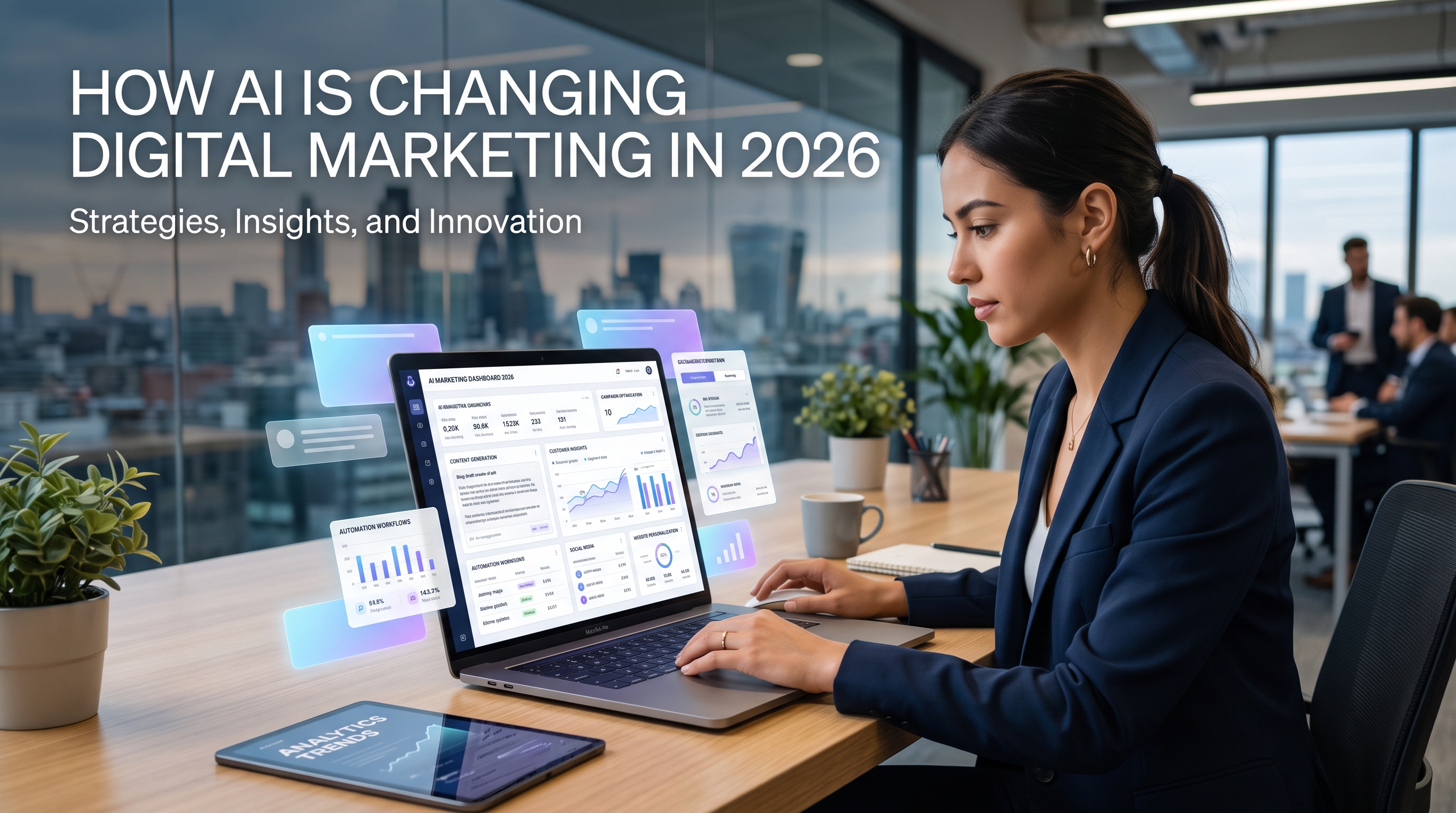
How AI Is Changing Digital Marketing in 2026
Digital marketing is changing quickly, and artificial intelligence is becoming an important part of that change. Businesses are using AI to understand customers, create content, analyze data, automate repetitive tasks, and improve the overall online experience.
In 2026, AI is no longer something that only large companies or technology teams can experiment with. Small businesses, freelancers, creators, agencies, and online stores can also use AI-powered tools to improve their marketing workflows.
The biggest change is not simply that AI can create content. AI is becoming part of the entire marketing process, from understanding an audience to creating campaigns and measuring results.
1. AI Is Making Content Creation Faster
Creating marketing content takes time. Businesses need social media posts, blog articles, product descriptions, email campaigns, advertisements, landing page copy, and other materials on a regular basis.
AI can help marketers generate initial ideas, outlines, headlines, descriptions, and variations much faster. Instead of starting every piece of content from a blank page, marketers can use AI as a starting point and then add their own experience, creativity, and brand voice.
This can be especially useful for small teams that need to maintain a consistent content schedule without spending hours on every draft.
2. Personalization Is Becoming More Practical
Customers do not always respond to the same message. Different audiences have different interests, needs, and reasons for purchasing a product or service.
AI can help businesses analyze customer behavior and create more relevant experiences. For example, an online store may recommend products based on browsing behavior, while a website can present different content depending on what a visitor is looking for.
Better personalization can make digital experiences feel more relevant instead of showing every customer exactly the same message.
3. AI Is Helping Marketers Understand Data
Modern marketing produces a large amount of data. Website visits, clicks, conversions, customer behavior, campaign performance, and social media engagement can all provide useful information.
The challenge is turning that information into something marketers can actually use.
AI-powered analytics tools can help identify patterns, summarize large amounts of information, and highlight areas that may require attention. This allows marketers to spend less time manually reviewing data and more time deciding what actions to take.
4. Marketing Automation Is Becoming Smarter
Automation has already been part of digital marketing for years, but AI is making automated workflows more flexible.
Businesses can use automation for tasks such as follow-up emails, customer notifications, lead management, content scheduling, and support workflows.
AI can add another layer by helping systems understand customer interactions and determine which information or action may be relevant next.
The goal is not to automate everything. The goal is to reduce repetitive work so marketers can focus on strategy, creativity, and customer relationships.
5. AI Is Changing Search and Website Discovery
People are changing the way they search for information online. Instead of relying only on traditional search queries, users increasingly expect direct answers, recommendations, summaries, and conversational experiences.
This means businesses need to think beyond traditional keyword optimization. Clear information, useful content, strong website structure, trustworthy information, and a good user experience remain important.
Businesses should focus on creating content that genuinely answers customer questions rather than producing content only for search engines.
6. AI Can Improve Customer Engagement
Customer expectations are changing. People want quick answers when they have questions about a product, service, order, or business.
AI assistants and conversational tools can help businesses provide information at different stages of the customer journey.
For example, an AI-powered website assistant can help visitors find services, understand product information, answer common questions, or guide them toward the right page.
Human support is still important, especially for complicated or sensitive situations. AI works best when it helps customers get faster answers while allowing human teams to handle cases that require personal attention.
7. AI Is Helping Businesses Create Better Marketing Ideas
Coming up with new campaign ideas can be difficult, especially for small marketing teams.
AI can help generate campaign concepts, audience angles, content themes, promotional ideas, and variations for different platforms.
However, marketers should not simply publish the first AI-generated idea. The strongest campaigns still require human understanding of the brand, audience, culture, and business goals.
8. AI Is Supporting Social Media Marketing
Social media requires consistent planning and content. AI can help marketers brainstorm posts, create content variations, organize ideas, and adapt a message for different platforms.
For example, one product announcement can be transformed into a short social post, a longer LinkedIn update, an email introduction, and website content.
This makes it easier for small teams to reuse valuable ideas without manually recreating every piece of content from scratch.
9. AI Is Changing E-Commerce Marketing
Online stores can use AI across several parts of the customer journey.
- Product recommendations
- Product description generation
- Customer segmentation
- Personalized promotions
- Shopping assistance
- Customer support
- Sales and customer behavior analysis
When these capabilities are combined with a well-designed website, businesses can create a more useful shopping experience while reducing some repetitive marketing tasks.
10. AI Is Making Small Teams More Competitive
One of the most important effects of AI is that smaller teams can accomplish more with limited resources.
A freelancer, startup, or small business may not have a large marketing department. AI tools can help them research ideas, prepare content, analyze performance, organize campaigns, and improve customer communication.
This does not remove the need for marketing knowledge. Instead, it can give smaller teams more leverage.
AI Does Not Replace Good Marketing Strategy
AI can generate content quickly, but speed alone does not create a successful marketing campaign.
A good marketing strategy still starts with understanding the audience, identifying a real problem, defining a clear message, choosing the right channel, and measuring meaningful results.
AI should support those decisions rather than replace them.
How Businesses Can Start Using AI
Businesses do not need to introduce dozens of AI tools at once. A better approach is to start with one repetitive or time-consuming marketing problem.
- Identify a repetitive marketing task.
- Choose an AI tool that can help with that task.
- Create a simple workflow.
- Review the AI-generated output before publishing.
- Measure whether the workflow actually saves time or improves results.
- Expand the workflow only when it provides real value.
Keep Humans in the Marketing Process
AI can help with speed, analysis, and automation, but human creativity and judgment remain important.
Marketers understand brand personality, customer emotions, cultural context, and business priorities in ways that automated systems may not fully understand.
The most effective approach is often a combination of AI efficiency and human decision-making.
AI and the Future of Digital Marketing
Digital marketing in 2026 is becoming more automated, personalized, and data-driven. AI is helping businesses move faster while creating new ways to communicate with customers.
For marketers, the important skill is not simply knowing how to use an AI tool. It is knowing how to use AI to solve a real business problem.
Whether you are running an online store, managing a service business, building a personal brand, or launching a startup, AI can become a useful part of your digital marketing workflow.
Final Thoughts
AI is changing digital marketing, but the fundamentals of good marketing have not disappeared. Businesses still need to understand their customers, provide value, build trust, and communicate clearly.
The difference is that AI can help businesses do many of these activities faster and at a larger scale.
In 2026, the opportunity is not simply to use AI because it is trending. The opportunity is to use it thoughtfully to create better content, smarter campaigns, stronger customer experiences, and more efficient marketing workflows.
Use AI to work smarter, but keep human creativity and strategy at the center of your marketing.