
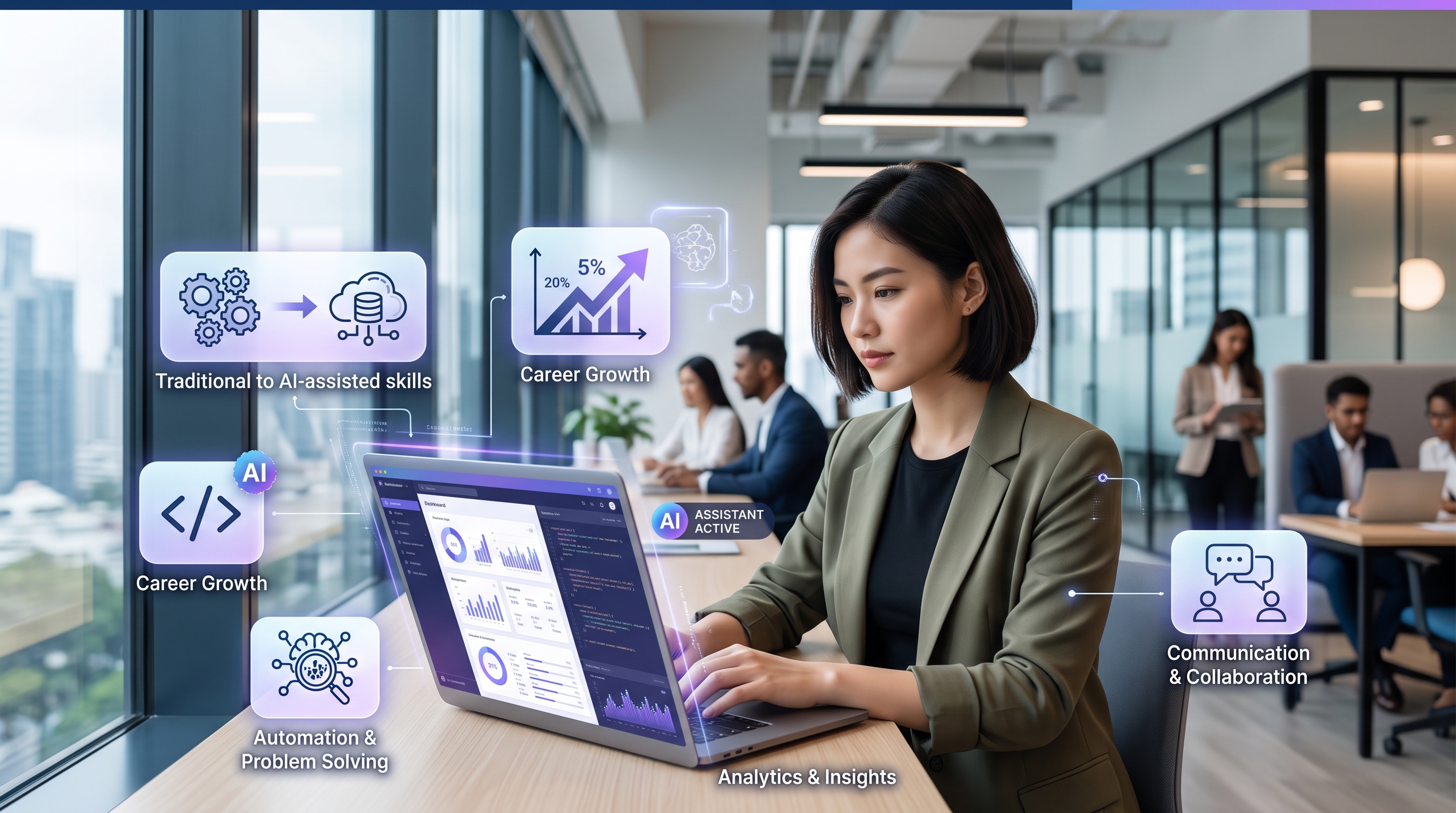
How AI Is Changing the Skills Employers Want in 2026
Artificial intelligence is changing the way many companies work. Tasks that once required significant amounts of manual effort can now be supported by AI tools, automation, and intelligent software.
For job seekers, this does not simply mean learning how to use an AI chatbot. The changing workplace is creating demand for a combination of technical knowledge, AI literacy, communication, problem-solving, adaptability, and strong human skills.
In 2026, building a career increasingly means understanding how to work effectively with technology while continuing to develop the skills that technology cannot easily replace.
AI Is Changing Jobs, Not Just Job Titles
When people talk about AI and employment, the conversation often focuses on whether AI will replace jobs. A more practical question for job seekers is how AI is changing the tasks performed within those jobs.
Many professionals may use AI to research information, summarize documents, generate ideas, analyze data, write initial drafts, automate repetitive processes, or support customer communication.
This means employers may increasingly value people who understand their profession and can use technology effectively to complete their work.
1. AI Literacy Is Becoming More Important
One of the most useful skills for modern job seekers is basic AI literacy. You do not necessarily need to become an AI researcher or machine learning engineer.
Instead, you should understand what AI tools can do, where they can help, what their limitations are, and how to use them responsibly.
Depending on your career, this might include using AI for research, writing, data analysis, programming, design, customer support, documentation, or workflow automation.
2. Problem-Solving Still Matters
AI can generate answers quickly, but knowing which problem to solve and how to evaluate a solution remains extremely important.
Employers need people who can understand a situation, identify the real problem, consider different solutions, and make informed decisions.
Instead of simply asking AI to solve everything, job seekers should learn to use AI as a tool that supports their own problem-solving process.
3. Communication Skills Are Still Valuable
Technology does not remove the need for people to communicate clearly. Employees still need to communicate with teammates, managers, customers, clients, and other stakeholders.
Strong communication includes explaining ideas clearly, asking useful questions, writing professional messages, listening carefully, and adjusting communication based on the audience.
As AI handles more routine tasks, the ability to communicate and collaborate effectively can become even more important.
4. Adaptability Can Make a Difference
AI tools and workplace technologies are changing quickly. A tool that is widely used today may be replaced or significantly improved in a short period of time.
For job seekers, this makes adaptability an important career skill. Instead of focusing only on one specific tool, develop the ability to learn new tools and understand new workflows.
A strong learner can continue developing their skills even when technology changes.
5. Technical Skills Are Evolving
Technical skills remain important, but the way professionals use them is changing.
For example, developers may use AI coding assistants to generate boilerplate code, explain unfamiliar code, identify possible bugs, or explore implementation approaches.
However, understanding programming fundamentals, architecture, debugging, security, performance, and software design is still important because AI-generated code needs to be reviewed and understood.
The same principle applies to other technical careers. AI can accelerate certain tasks, but strong fundamentals help professionals use AI effectively.
6. Critical Thinking Is Essential
AI-generated information is not automatically correct. AI systems can produce inaccurate, incomplete, outdated, or misleading information.
Job seekers should therefore develop the ability to question information, verify important facts, compare sources, and identify weaknesses in an answer.
Being able to say “this result does not look correct, and here is why” can be more valuable than simply knowing how to generate an answer.
7. Data Skills Are Becoming More Useful
Many businesses rely on data to understand customers, sales, operations, marketing, and performance.
Job seekers do not necessarily need to become professional data scientists. Basic data literacy can still be valuable.
Understanding spreadsheets, charts, metrics, dashboards, basic analysis, and data-driven decision-making can help professionals work more effectively with modern business tools.
8. Creativity Still Has a Place
AI can generate ideas, images, text, designs, and other forms of content. However, creativity is not simply about producing more content.
Good creative work requires understanding an audience, identifying a meaningful idea, making decisions, developing a clear direction, and improving the final result.
Job seekers can use AI to explore ideas faster while still developing their own creative judgment and perspective.
9. Employers May Value AI-Assisted Productivity
Knowing how to complete a task is useful. Knowing how to complete that task efficiently using the right tools can be even more valuable.
Professionals who can combine their existing skills with AI and automation may be able to reduce repetitive work and spend more time on higher-value activities.
For example, a marketer might use AI to generate initial campaign ideas, while a developer might use AI to accelerate repetitive coding tasks. The professional still provides the expertise, review, and final decision-making.
10. Human Skills Still Matter
Not every valuable workplace skill is technical.
Teamwork, empathy, leadership, negotiation, communication, reliability, professionalism, and relationship-building remain important in many careers.
These skills become particularly valuable in situations where people need to understand one another, resolve disagreements, build trust, or make decisions involving multiple stakeholders.
Build Skills Around Your Career Goal
Job seekers should avoid trying to learn every new AI tool they see online. Instead, start with the career you want and identify the skills that matter for that role.
For example:
- A developer can focus on programming fundamentals, AI-assisted development, debugging, system design, and software architecture.
- A marketer can develop skills in content strategy, analytics, customer research, automation, and AI-assisted content creation.
- A designer can combine design fundamentals with modern design tools, AI-assisted workflows, and strong visual judgment.
- A customer support professional can develop communication, troubleshooting, product knowledge, documentation, and AI-assisted support skills.
- A business professional can focus on data literacy, communication, process improvement, automation, and AI-supported decision-making.
How to Show AI Skills on Your Resume
Simply writing “AI skills” on a resume may not tell an employer much. Whenever possible, demonstrate how you have actually used AI or automation to improve your work.
For example, instead of only saying that you know AI tools, describe a project or workflow where you used AI to research information, automate a repetitive task, improve productivity, analyze data, or support a business process.
Real examples can provide more context than a list of tool names.
Build Projects, Not Just Certificates
Courses and certificates can help you learn, but practical projects can demonstrate how you apply your knowledge.
Job seekers can build small projects that combine their professional skills with AI. A developer might create an AI-assisted application. A marketer could build an automated content workflow. A student could create a research or productivity tool.
The project does not need to be complicated. What matters is showing your thinking, process, skills, and results.
Don't Depend Completely on AI
One important career skill in the AI era is knowing when not to use AI.
If you rely on AI for every task, you may stop developing your own understanding. Over time, this can make it harder to solve problems independently or recognize when an AI-generated answer is incorrect.
Use AI to accelerate your work, but continue learning the fundamentals behind what you do.
A Simple Skill-Building Plan for Job Seekers
If you are preparing for the job market, you can follow a simple approach:
- Choose the career or role you want.
- Identify the core skills required for that role.
- Learn the fundamentals before relying heavily on AI tools.
- Learn the AI tools that are relevant to your profession.
- Build practical projects.
- Document your work and results.
- Create a professional resume and portfolio.
- Practice communication and interview skills.
- Continue learning as technology changes.
The Future Belongs to People Who Keep Learning
AI is changing the workplace, but the most important response for job seekers is not to chase every new technology. It is to become a stronger professional who knows how to learn, adapt, communicate, solve problems, and use modern tools responsibly.
The combination of professional expertise and AI literacy can help people work more efficiently while maintaining human judgment and accountability.
Final Thoughts
The skills employers want in 2026 are not limited to technical AI knowledge. Job seekers can benefit from developing a balanced skill set that combines AI literacy, technical fundamentals, critical thinking, communication, creativity, adaptability, data awareness, and practical experience.
AI can become a powerful career tool when you learn how to work with it instead of depending entirely on it.
The goal is not to compete with every AI tool. The goal is to become a professional who knows how to use technology, think independently, and create real value.