
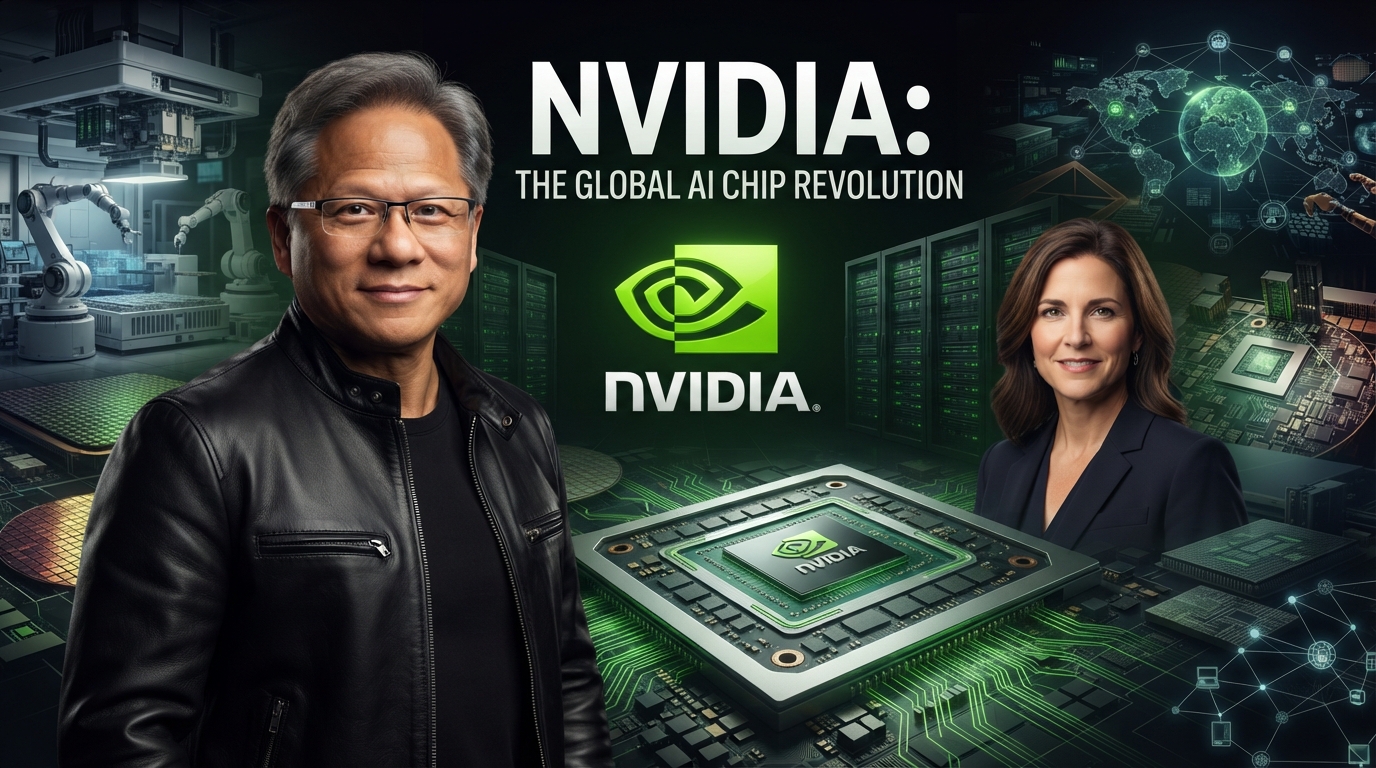
Introduction: NVIDIA and the AI Revolution
The global technology industry is experiencing one of the biggest transformations in its history. Artificial intelligence, cloud computing, autonomous vehicles, robotics, and advanced data centers are changing how businesses operate.
At the center of this transformation is NVIDIA, one of the world's most influential semiconductor and computing companies. Founded in 1993 by Jensen Huang, Chris Malachowsky, and Curtis Priem, NVIDIA initially became famous for developing graphics processing units (GPUs) for computer gaming.
Today, NVIDIA's technology powers some of the world's largest AI data centers, research laboratories, cloud platforms, and enterprise computing systems.
NVIDIA is no longer simply a graphics card manufacturer. It has become a major provider of the computing infrastructure required to develop, train, and operate modern artificial intelligence systems.
But how does NVIDIA actually make money? Who manufactures its chips? How does the global semiconductor supply chain work? And why is the company so dominant in the AI market?
Let's explore the entire industry.
1. Understanding the Global Semiconductor Industry
A semiconductor is a material used to control the flow of electrical current. Semiconductor chips are tiny electronic components that perform calculations, process information, store data, and control devices.
Almost every modern electronic product depends on semiconductors, including smartphones, laptops, gaming consoles, cars, medical equipment, cloud computing platforms, and artificial intelligence systems.
Major Participants in the Semiconductor Industry
- Chip designers: NVIDIA, AMD, Qualcomm, and Broadcom.
- Foundries: TSMC, Samsung Foundry, and Intel Foundry.
- Memory manufacturers: SK hynix, Samsung Electronics, and Micron.
- Manufacturing equipment providers: ASML, Applied Materials, Lam Research, and KLA.
- Packaging and testing companies: ASE Technology and Amkor.
These companies work together to design, manufacture, assemble, test, and distribute semiconductor products worldwide.
2. NVIDIA's Business Model: What Does the Company Actually Sell?
NVIDIA operates primarily as a fabless semiconductor company. This means it designs its own processors and computing platforms but relies on external manufacturing partners to fabricate many of its chips.
A. Data Center and Artificial Intelligence
NVIDIA's Data Center business is its largest revenue source. Modern AI models require enormous amounts of computing power to train and operate.
Important products include:
- NVIDIA H100 and H200 GPUs
- NVIDIA Blackwell architecture
- NVIDIA B200 and GB200 systems
- NVIDIA DGX systems
- NVIDIA NVLink networking technology
- NVIDIA InfiniBand and Spectrum-X networking
B. Gaming
NVIDIA originally established its reputation through gaming graphics cards. Its GeForce GPUs are widely used by PC gamers, developers, and content creators.
Its technologies support ray tracing, AI-assisted rendering, advanced graphics, and cloud gaming through GeForce NOW.
C. Professional Visualization
NVIDIA provides specialized graphics hardware and software for architecture, engineering, film production, visual effects, 3D modeling, and industrial simulations.
D. Automotive and Robotics
NVIDIA's DRIVE platform supports automotive computing and autonomous driving applications. Its Jetson platform provides computing technology for robotics and edge AI systems.
E. Enterprise Software and AI Platforms
NVIDIA's software ecosystem is one of its biggest competitive advantages. CUDA, TensorRT, NVIDIA AI Enterprise, and related development tools help developers build and optimize applications for NVIDIA hardware.
3. NVIDIA's Financial Growth: How Big Has the Business Become?
NVIDIA's financial performance demonstrates how quickly demand for AI computing has expanded.
According to its fiscal year 2026 annual report, covering the year ended January 25, 2026, the company reported the following results:
- Total revenue: $215.9 billion
- Gross margin: 71.1%
- Operating income: $130.4 billion
- Net income: $120.1 billion
- Revenue growth: 65%
Revenue by Business Segment
- Data Center: $193.7 billion
- Gaming: $16.0 billion
- Professional Visualization: $3.2 billion
- Automotive: $2.3 billion
- OEM and Other: $0.6 billion
These figures show that NVIDIA's business has fundamentally changed. Gaming helped establish the company, but AI infrastructure now represents the overwhelming majority of its revenue.
4. How NVIDIA Chips Are Manufactured
Designing a semiconductor chip and physically manufacturing it are two completely different processes. NVIDIA focuses heavily on chip architecture and engineering while relying on specialized manufacturing partners.
Step 1: Chip Architecture and Design
NVIDIA engineers design the architecture of processors, including processing cores, memory interfaces, cache systems, and other components. The designs go through extensive simulation, engineering, and verification.
Step 2: Semiconductor Manufacturing at TSMC
After the design is completed, NVIDIA works with manufacturing partners. Taiwan Semiconductor Manufacturing Company (TSMC) is a particularly important partner in producing advanced NVIDIA chips.
Step 3: High-Bandwidth Memory
AI accelerators require extremely fast memory. High-Bandwidth Memory (HBM) allows processors to access large quantities of data at high speeds.
Major memory suppliers include SK hynix, Samsung Electronics, and Micron Technology.
Step 4: Advanced Packaging
Advanced AI processors often combine multiple silicon components in a single package. Technologies such as TSMC's CoWoS (Chip on Wafer on Substrate) help integrate processors and high-bandwidth memory.
Step 5: Testing and Integration
Manufactured components undergo quality testing and verification before being integrated into accelerator modules, server boards, and complete AI computing systems.
Step 6: Distribution
Finished products are delivered to cloud providers, data center operators, enterprise customers, research institutions, and technology companies around the world.
5. NVIDIA's Global Supply Chain: Who Makes the Components?
NVIDIA does not manufacture every component of its AI computing systems independently. Its supply chain includes specialized companies from Taiwan, South Korea, the United States, and other countries.
Important Supply Chain Companies
- TSMC: Manufactures advanced semiconductor chips.
- SK hynix: Produces high-bandwidth memory.
- Samsung Electronics: Supplies memory and semiconductor manufacturing services.
- Micron Technology: Develops advanced memory solutions.
- ASML: Manufactures advanced lithography equipment used in semiconductor production.
- ASE Technology: Provides semiconductor assembly and packaging services.
- Amkor: Provides semiconductor packaging and testing services.
This interconnected ecosystem is essential to NVIDIA's success. A shortage of advanced memory, packaging capacity, manufacturing equipment, or fabrication services can affect the entire AI hardware market.
6. NVIDIA's Market Share: How Dominant Is the Company?
Market share is one of the most frequently discussed topics in the semiconductor industry. However, there is no single market-share percentage for NVIDIA across the entire semiconductor industry.
The overall semiconductor market includes memory, processors, analog chips, and many other products. The AI accelerator market, on the other hand, focuses on specialized hardware used for AI workloads.
Some industry estimates place NVIDIA's share of the AI accelerator market at approximately 80% or more, depending on the definition, reporting period, and whether custom AI chips are included.
Why Is NVIDIA So Competitive?
- High-performance GPU architecture.
- CUDA and its extensive developer ecosystem.
- Strong relationships with cloud computing providers.
- Advanced networking and complete computing systems.
- Deep integration between hardware and software.
- Significant investment in AI research and development.
NVIDIA's competitive advantage is not based on hardware alone. Its software ecosystem makes it difficult for customers to move their workloads to competing platforms.
7. NVIDIA's Biggest Competitors
AMD
Advanced Micro Devices is one of NVIDIA's strongest direct competitors. Its Instinct accelerator products target AI training and inference workloads. AMD also develops EPYC server processors and Radeon graphics products.
Intel
Intel is a major semiconductor company with a long history in CPUs and data center computing. It competes through server processors, accelerator products, and semiconductor manufacturing.
Broadcom
Broadcom plays an important role in custom AI accelerator development and networking technology. Large technology companies increasingly consider custom application-specific integrated circuits (ASICs) as alternatives to general-purpose GPUs for certain workloads.
Google develops its own Tensor Processing Units (TPUs). These specialized processors accelerate machine learning workloads within Google's infrastructure and cloud ecosystem.
Amazon
Amazon develops its own AI chips, including Trainium and Inferentia, to provide alternative AI computing options within Amazon Web Services (AWS).
Microsoft
Microsoft is developing its own AI infrastructure and custom silicon initiatives to support its cloud and AI services.
These companies compete on computing performance, energy efficiency, software compatibility, networking, and infrastructure costs.
8. Why AI Companies Need So Many NVIDIA GPUs
Training modern AI models requires processing enormous datasets through billions or trillions of mathematical operations.
Traditional CPUs are designed to handle a wide range of computing tasks. GPUs, on the other hand, can execute many similar mathematical operations in parallel, making them particularly effective for deep learning and many AI workloads.
Large AI data centers combine thousands of accelerators with:
- High-speed networking
- Advanced cooling systems
- High-performance memory
- Large-scale storage infrastructure
- Powerful electrical systems
- Specialized AI software
These systems work together as large-scale computing clusters, creating demand across the semiconductor, networking, energy, and data center industries.
9. The Biggest Challenges Facing NVIDIA
Despite its enormous growth, NVIDIA faces several important business and industry risks.
- Supply chain dependence: NVIDIA relies on external manufacturing and packaging partners.
- Competition: AMD, Google, Amazon, Broadcom, and other companies are investing in alternative AI hardware.
- Export restrictions: International trade regulations can affect access to important markets.
- Customer concentration: A relatively small number of major customers account for a substantial portion of its business.
- Energy consumption: AI data centers require enormous amounts of electricity and sophisticated cooling systems.
- Custom AI chips: Cloud providers may increasingly develop their own processors.
- Valuation risk: High expectations for AI growth can create financial-market volatility.
10. The Future of the Global Semiconductor Industry
The semiconductor industry is likely to become even more important over the coming decade. Several major trends are shaping its future.
AI Infrastructure Expansion
Companies worldwide are investing in AI data centers, cloud platforms, and specialized computing infrastructure.
Custom AI Accelerators
Technology companies are increasingly designing their own processors to optimize specific AI workloads and reduce computing costs.
Advanced Packaging
As processors become more complex, advanced packaging technologies are becoming increasingly important for performance and manufacturing efficiency.
High-Bandwidth Memory
The growing demand for AI computing is increasing the importance of advanced memory technologies.
Robotics and Autonomous Systems
AI is expanding beyond software into physical machines, industrial automation, autonomous vehicles, and intelligent robotics.
Semiconductor Manufacturing Diversification
Governments and companies are investing in domestic semiconductor manufacturing capacity to improve supply-chain resilience.
Conclusion: NVIDIA Is More Than a Chip Company
NVIDIA's rise demonstrates how a company can transform an entire industry by combining hardware innovation, software development, and a strong business ecosystem.
Its dominance in AI computing is supported by advanced GPU technology, CUDA, networking products, manufacturing partnerships, and growing demand for AI infrastructure.
However, NVIDIA's success also depends on companies such as TSMC, SK hynix, Samsung, Micron, ASML, and many other semiconductor suppliers.
The global chip industry is a connected ecosystem, and every participant plays an important role.
As artificial intelligence continues to evolve, semiconductor technology will remain one of the most strategically important industries in the world.
The next generation of technological innovation will not only be built with software. It will be powered by the chips, factories, memory, networks, and computing infrastructure behind it.
Sources and Further Reading
- NVIDIA Investor Relations
- Taiwan Semiconductor Manufacturing Company
- ASML
- SK hynix
- Micron Technology
- AMD
- OECD
Editorial note: Financial figures refer to NVIDIA fiscal year 2026, not calendar year 2026. Market-share estimates vary by product category and methodology. This article is for educational and industry research purposes, not investment advice.