
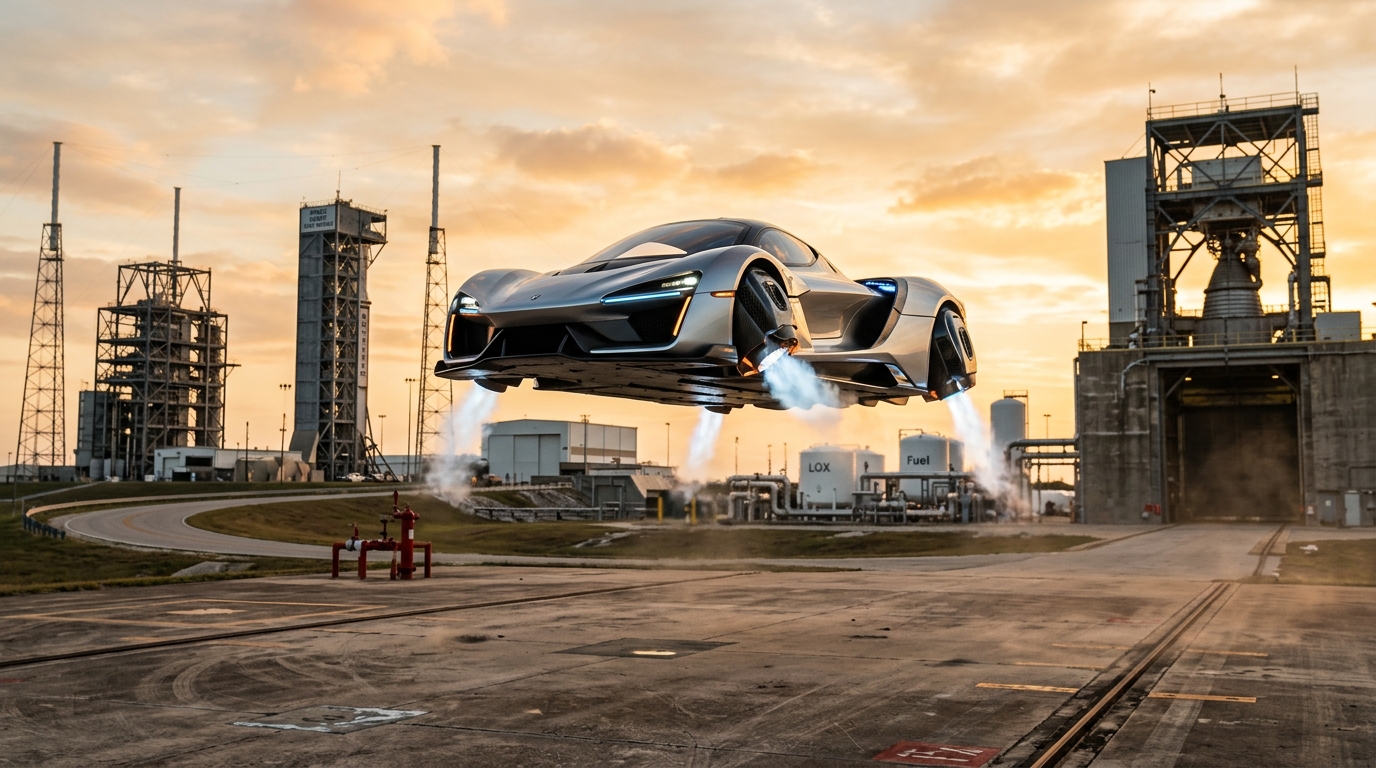
Few cars have kept enthusiasts waiting as long as the second-generation Tesla Roadster. Tesla first showed it in 2017 and promised deliveries by 2020. After years of delays, missed dates and shifting priorities, the company finally unveiled a redesigned version on October 15, 2026. It is less a traditional sports car than a showcase of unusual technology: fan-based suction downforce, cold-gas thrusters developed with SpaceX, and a version that Tesla says can fly.
This post covers what Tesla showed, how the technology works, which claims are still unverified, and what the Roadster could mean for future innovation.
A Nearly Decade-Long Wait
The Roadster name goes back to Tesla's first production car, the original Roadster, which arrived in 2008 and helped prove that electric cars could be fast and desirable. It was a small, lightweight two-seater, and it changed how many people thought about EVs.
In November 2017, Tesla revealed a much more ambitious successor and made bold promises about acceleration and range. Deliveries were expected in 2020. They never happened. Over the following years Tesla focused on higher-volume vehicles, driver-assistance and autonomy software, robotics and energy products. The Roadster turned into a running joke among fans and critics alike.
Along the way, Elon Musk repeatedly said the car would be worth the wait and that it would be very different from what Tesla had shown before. Reports also said the project evolved into an all-new design rather than a simple update of the 2017 concept. When Tesla finally announced a date, it was a notable moment for a car that many had written off as vaporware.
The Unveil Event
Tesla teased a "Go for launch" event in September 2026, put a countdown on its website, and invited early reservation holders. The reveal was first set for October 1, but severe weather pushed it back two weeks. The event finally took place on October 15 at SpaceX's test facility in McGregor, Texas.
The choice of location was deliberate. Much of what makes this Roadster unusual comes from SpaceX engineering, and McGregor is where SpaceX tests rocket hardware. Tesla used the livestream to show the car running, launching and performing aerial stunts, including a jump that ended with the car landing after an inverted ramp.
Tesla also reopened Roadster reservations. The company has been clear, however, that this was an unveil of a production-style design and not a delivery event.
Three Versions, One Platform
Instead of a single car, Tesla presented the Roadster as one platform with three configurations. Each adds more hardware and more extreme performance.
- Performance: the road-ready two-seater. It has active aerodynamics and a multi-mode suction system. Tesla claims 0-60 mph in under 1.6 seconds, which already beats the 1.9-second figure promised back in 2017.
- Thrust: the race-ready two-seater. It adds rear-mounted cold-gas thrusters on top of the suction system. Tesla claims 0-60 mph in under 0.9 seconds.
- Rocket: a single-seater built for short flights. It adds thrusters around the car's perimeter, so it can push forward, lift and rotate. Tesla claims 0-60 mph in under 0.59 seconds and a top speed above 230 mph.
Across the lineup, Tesla quotes a range of more than 300 miles. Coverage after the event described Thrust and Rocket as upgrades, or "augments," on top of the Performance car.
All of these numbers are Tesla's claims. For perspective, the Thrust and Rocket figures are far beyond anything currently sold, including the Rimac Nevera, which has been one of the quickest production cars on the market.
The Technology Behind the Roadster
The Roadster is interesting less for any single number than for the collection of ideas packed into one car. Here is how each major system works.
1. Cold-Gas Thrusters
The headline feature comes from Tesla's collaboration with SpaceX. A cold-gas thruster is one of the simplest rocket-style devices there is. Instead of burning fuel, it stores gas under high pressure and releases it through a nozzle. The gas rushes out one way and the vehicle is pushed the other way. There is no combustion, so no fire and no exhaust plume.
The Roadster's version uses compressed air. Reports from the event say the Thrust version carries a 200-litre pressurized tank feeding four rear thrusters. The Rocket adds another 400-litre tank, for about 600 litres in total, and six more thrusters around the body.
The idea matters because of how cars normally accelerate. A conventional car, even an electric one with huge power, is limited by how much force its tires can transfer to the road. Past a certain point, extra power only spins the wheels. Thrusters push on the car directly, so they are not limited by tire grip. Tesla says the thrusters generate roughly four to five times the force the tires can handle, which is how it gets sub-second acceleration claims.
There is a trade-off. Compressed gas runs out. A thruster burst lasts for a limited time and the tanks must be refilled, so these systems suit short, intense runs rather than constant use. Tesla has not yet explained how long refills take or how many cycles the hardware can handle.
2. Multi-Mode Suction System
All three versions use fans under the floor that pull the car toward the road. This creates downforce, which is extra downward pressure that improves grip. Normal racing cars get downforce from wings and shaped underbodies, but those depend on airspeed, so they do little at low speed. A fan-based system can create suction even when the car is moving slowly or standing still.
Tesla says the system is powerful enough to hold the car to a surface even upside down. That is mostly a demonstration of capability, but the practical benefits are real: stronger launches, higher cornering speeds and shorter braking distances. The system has several modes, so the car can balance grip against efficiency depending on the situation.
Fan-based downforce has been seen before in motorsport, and the concept is not new. What stands out is the plan to include it in a car intended for road use.
3. Active Aerodynamics
The Roadster also uses moving aerodynamic surfaces that change with speed and driving mode. Reports say the wings are driven by electric actuators related to those used in Tesla's Optimus humanoid robot. That is a good example of Tesla reusing components across very different products, which can lower costs and speed up development.
4. Steer-by-Wire and Flight Stabilization
The car uses a yoke instead of a steering wheel, with steer-by-wire controls. This means there is no direct mechanical link between the yoke and the wheels. Software reads the driver's input and moves the wheels electronically. It allows flexible tuning of steering feel and makes it easier to integrate with other systems.
The thrusters rely on similar technology. Tesla says all-electric actuators make small adjustments to the thrusters so the car stays stable when airborne. Controlling a car in mid-air is a very different job from controlling it on the road, and fast, precise software control is what makes the Rocket's hops, rotations and landings possible.
5. The Electric Drivetrain
Underneath all the spectacle is a battery-electric powertrain. Tesla is targeting a top speed above 230 mph and a range above 300 miles. It has not published a detailed breakdown of battery capacity, motor count or power output, so those specifics are still unknown.
The Live Demo: Impressive but Unverified
During the event, Tesla showed a 0-60 mph run of 0.81 seconds, or about 0.67 seconds if the usual rollout is not counted. Tesla also described the Thrust version's thrusters as producing more than 4 Gs of acceleration during a run, a figure Musk shared after the event.
These results deserve some caution. The 0.81-second time was not independently timed. It was also slower than the sub-0.59-second claim for the Rocket, which reflects the gap between a demonstration and a final production specification. Independent testers will want to measure the car on different surfaces, in different conditions and over repeated runs before the numbers can be trusted.
How the Roadster Compares
Until now, the quickest electric hypercars have relied on multiple powerful motors, advanced batteries and sticky tires. They are extremely fast, but they are bound by the same traction limits as every other car.
The Roadster tries a different approach. The Performance version competes in the same class as the fastest cars on sale, while the Thrust and Rocket versions step outside that class entirely by adding non-tire forces. That makes direct comparisons difficult. It is closer to a new category than a faster version of an existing one, and it also means the car must prove itself against new questions about safety, durability and legality.
What We Still Don't Know
- Price: Tesla has not given a clear final price for each version, and coverage after the event noted there was still no price.
- Production date: Tesla has not committed to a firm date. Earlier statements pointed to production in 2027, while some more recent reports mention 2028.
- Range: some outlets pointed out that the current range claim is well below earlier Tesla targets, so final figures may still change.
- Road legality: it is unclear how thrusters, suction fans and flight features would be certified for public roads in different countries.
- Durability and servicing: refill times, tank safety checks and the lifespan of the thruster hardware have not been explained in detail.
- Safety: Musk has hinted that thrill matters more than conventional safety metrics for this car, but regulators will have a say.
Future Plans and Impact on Innovation
Tesla has reopened reservations, and earlier statements say the car is planned for Gigafactory Texas. Until a delivery date is confirmed, the Roadster works mainly as a public test bed for ideas that could reach other products.
Where the Technology Could Spread
- Suction downforce: could lead to better grip and shorter braking distances in performance cars, track cars and possibly other vehicles.
- Cold-gas thrusters: could inspire new ways to stabilize, launch or maneuver vehicles beyond what tire traction allows.
- Shared actuators: reusing parts from the Optimus robot shows how robotics and automotive engineering can feed each other, lowering costs and speeding up progress.
- Steer-by-wire controls: could make flexible, software-driven vehicle controls more common across the industry.
- Active aerodynamics: faster, lighter actuators could improve efficiency as well as performance in everyday cars.
The Bigger Picture
The Roadster is unlikely to change everyday driving, since very few people will ever own one. Its real value may be in showing what is possible and pushing rivals and engineers to rethink long-held limits on grip and acceleration. Halo cars have often worked this way. Technologies such as turbocharging, carbon fiber structures and active suspension started in expensive, extreme vehicles and gradually reached ordinary cars.
There is also a branding effect. Tesla has said it is increasingly focused on AI, autonomy and robotics, and the Roadster shows its engineers can still deliver spectacle in hardware. The risk is that attention could turn into disappointment if delays continue or if real-world performance falls short of the demos. Much of this is still speculation, and it depends on the technology proving safe, repeatable and legal on public roads.
Frequently Asked Questions
When was the new Tesla Roadster unveiled?
Tesla unveiled the redesigned second-generation Roadster on October 15, 2026, after the event was moved from October 1 because of weather.
Can the Roadster really fly?
Tesla says the single-seat Rocket version can lift off, move through the air and land, using thrusters placed around the car. The flights shown were short hops, and independent verification is still needed.
How fast is it?
Tesla claims 0-60 mph in under 1.6 seconds for Performance, under 0.9 seconds for Thrust and under 0.59 seconds for Rocket, with a top speed above 230 mph. The live demo run recorded 0.81 seconds and was not independently timed.
When can you buy one?
Reservations are open, but Tesla has not announced a firm delivery date or final pricing.
Conclusion
The new Tesla Roadster combines an electric drivetrain, fan-based downforce, active aerodynamics, steer-by-wire controls and SpaceX-style cold-gas thrusters. It is an ambitious attempt to get around the limits that hold back every conventional car. The claims are extraordinary, which is exactly why they deserve scrutiny.
Watch for independent testing, final pricing and a confirmed production date before drawing conclusions. If the technology works as promised, its influence could reach well beyond one supercar. If it does not, the Roadster will remain a spectacular demonstration. Either way, it has already shown how much room is left to rethink performance.