
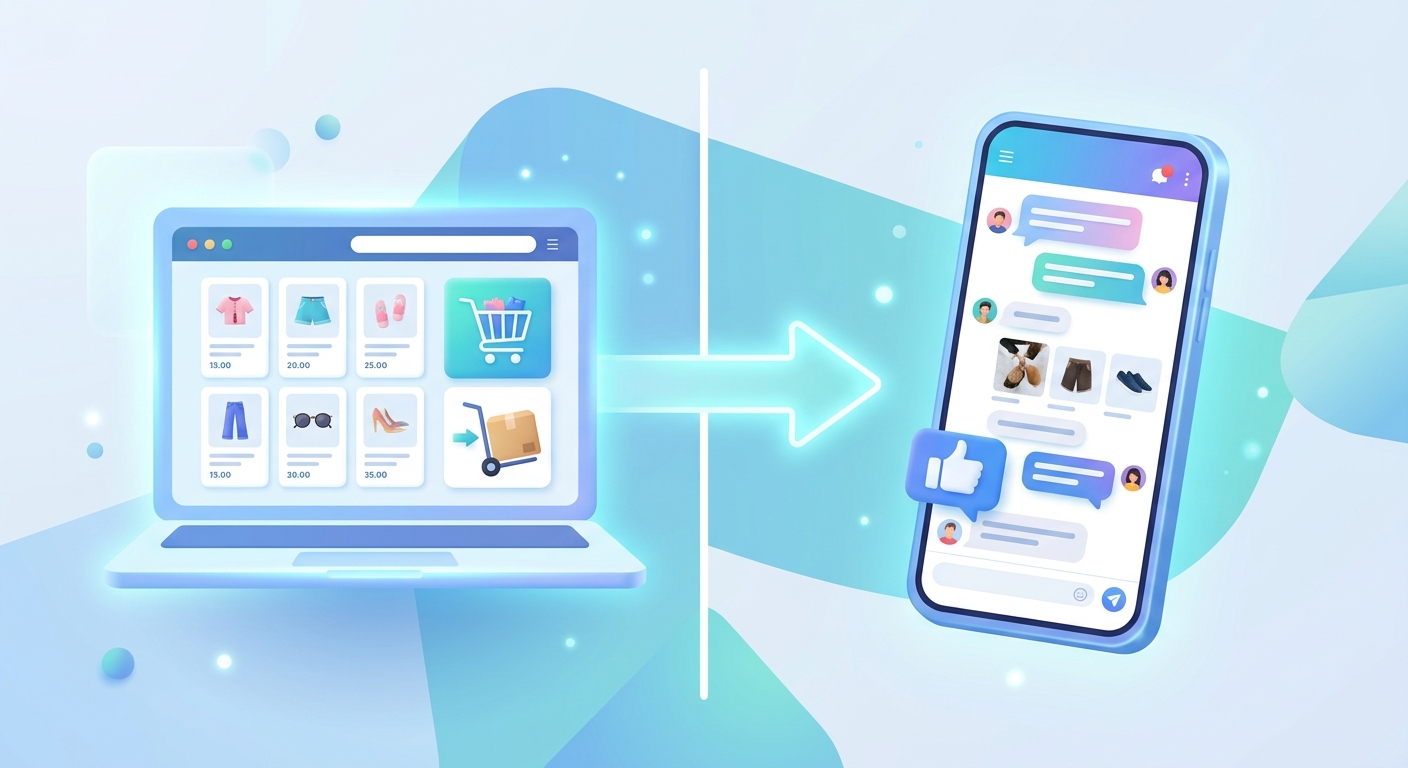
Online selling comes in several forms, and two terms confuse many new business owners: e-commerce and f-commerce. Both let you sell without a physical shop, but they work differently. They differ in where customers shop, how much you spend to start, how much trust you build and how far you can grow.
This guide explains each model in plain language, compares them point by point, and helps you decide which one fits your business.
The Quick Answer
E-commerce is selling through your own website, app or an online marketplace. F-commerce (Facebook commerce) is selling through Facebook pages, groups, Messenger and Facebook Shops. F-commerce is a smaller, social-media-based branch of the wider online selling world.
In short, e-commerce gives you more control, structure and scale. F-commerce gives you a fast, cheap start and direct conversations with buyers.
What Is E-Commerce?
E-commerce means buying and selling goods or services over the internet. The seller runs a dedicated online store, or lists products on a marketplace such as Amazon or Daraz. Customers browse a catalogue, add items to a cart, pay online and receive delivery.
Common e-commerce models
- Your own website: a store built on a platform such as Shopify or WooCommerce.
- Marketplaces: you list products on a large platform and pay fees or commission.
- Mobile apps: a branded shopping app for repeat customers.
What Is F-Commerce?
F-commerce is short for Facebook commerce. Sellers use a Facebook business page, groups, Messenger chats and Facebook Shops to show products, answer questions and take orders. Many sales are closed in the chat itself, often with cash on delivery or a mobile payment.
F-commerce is part of the wider idea of social commerce, which also includes selling on Instagram, WhatsApp and TikTok.
How a typical f-commerce sale works
- The seller posts photos and prices on a Facebook page.
- A customer sees the post or an ad and sends a message.
- The seller confirms the order, address and payment in chat.
- The seller arranges delivery through a courier.
E-Commerce vs F-Commerce: Key Differences
1. Where the selling happens
- E-commerce: on a website, app or marketplace built for shopping.
- F-commerce: inside Facebook, mostly in posts and private chats.
2. Startup cost and technical skill
- E-commerce: needs a domain, hosting or a platform subscription, product pages, a payment gateway and ongoing maintenance.
- F-commerce: needs very little money to start compared with an independent website, and little technical skill.
3. Control and branding
- E-commerce: you control the design, checkout, policies and customer data.
- F-commerce: you follow Facebook’s rules and layout. If the page is restricted or the platform changes, your sales can suffer.
4. Order handling and payments
- E-commerce: automated carts, online payments, order tracking and stock updates.
- F-commerce: orders are usually handled by hand in chat. This feels personal but becomes slow and error-prone as orders grow.
5. Customer trust
- E-commerce: established platforms usually offer return policies, support systems and seller checks.
- F-commerce: trust is harder to build, because many sellers run with fewer formal return policies and verification steps. Reviews, live videos and quick replies help close the gap.
6. Logistics and delivery
- E-commerce: larger stores often have built-in or partnered delivery systems.
- F-commerce: small sellers often lack a dedicated shipping system and book couriers one order at a time.
7. Marketing and discovery
- E-commerce: customers find you through search engines, ads, email and marketplaces. SEO matters.
- F-commerce: customers find you through social posts, shares, groups and Facebook ads. Engagement and reputation matter.
8. Customer relationship
- E-commerce: relationships are built through email lists, accounts and loyalty programs.
- F-commerce: relationships are built through direct conversations, which can feel friendly and personal.
9. Data and analytics
- E-commerce: detailed data on traffic, carts, conversion and repeat buyers.
- F-commerce: limited to page insights and what you note down yourself.
10. Scalability
- E-commerce: built to handle thousands of orders, products and markets.
- F-commerce: works well for small catalogues and low volume, but strains as you grow.
Pros and Cons
Benefits of e-commerce
- Full control over brand, pricing and customer data
- Automated checkout, payments and inventory
- Strong potential for search traffic and long-term growth
- Easier to scale and sell in new markets
Drawbacks of e-commerce
- Higher setup and maintenance cost
- Needs technical and marketing skills
- New stores take time to earn traffic and trust
Benefits of f-commerce
- Almost free to start
- Huge ready-made audience
- Instant, personal conversations that help close sales
- Popular with younger shoppers who already live on social media
Drawbacks of f-commerce
- Dependence on one platform and its rules
- Manual order handling and record keeping
- Weaker trust signals and fewer formal protections for buyers
- Hard to scale without extra tools
The Bangladesh Example
Bangladesh is one of the best-known f-commerce markets. Facebook stores there have come to outnumber sellers on local e-commerce websites, partly because no major platform existed to absorb all the business. Around 2020, the e-commerce association e-CAB reported about Tk7,000 crore in traditional e-commerce against about Tk1,000 crore in f-commerce. Another report counted roughly 2,000 dedicated e-commerce platforms against more than 300,000 business pages on Facebook.
The same sources point to common problems: weak logistics, little regulation of Facebook sellers and uneven trust. The market keeps moving, too. In 2026, Pathao launched Pathao Commerce, a platform that bundles storefronts, orders, inventory, payments, delivery and customer chat for f-commerce merchants. That shows how the industry is helping social sellers move toward more complete e-commerce tools.
Which One Should You Choose?
Choose f-commerce if you:
- Are testing a product idea with very little money
- Sell to a local, social-media-active audience
- Have a small catalogue and low order volume
- Enjoy chatting with customers directly
Choose e-commerce if you:
- Want to build a lasting brand you fully control
- Expect many orders and a growing product range
- Need automated payments, tracking and inventory
- Want customers to find you through search engines
The best answer is often both
Many successful sellers use Facebook to attract and talk to customers, then send them to their own website to check out. This mix combines the reach of f-commerce with the structure of e-commerce.
How to Move From F-Commerce to E-Commerce
- Keep your Facebook page active. It is your audience and your proof of reputation.
- Launch a simple online store with your best-selling products first.
- Add online and mobile payment options next to cash on delivery.
- Set a clear return and refund policy and show it on every page.
- Connect a courier service so delivery is booked and tracked automatically.
- Send chat customers to your store with links in posts and replies.
- Collect emails or phone numbers so you own the relationship, not just the page.
Frequently Asked Questions
Is f-commerce a type of e-commerce?
Yes. F-commerce is a form of e-commerce that happens inside Facebook rather than on a standalone store.
Is f-commerce cheaper than e-commerce?
To start, yes. You can open a page for free. Costs rise later through ads, time spent in chats and delivery handling.
Which is safer for buyers?
Established e-commerce platforms generally offer clearer policies and support. F-commerce varies by seller, so buyers should check reviews, ask questions and prefer sellers with a clear return policy.
Can I run both?
Yes, and many businesses do. Use Facebook for discovery and conversation, and your own store for checkout and records.
Is f-commerce the same as social commerce?
Not exactly. F-commerce is social commerce on Facebook. Social commerce is the broader term and also covers Instagram, WhatsApp, TikTok and others.
Final Thoughts
F-commerce is the quickest and cheapest way to begin selling online, while e-commerce is the stronger base for growth, trust and control. If you are just starting, test your products on Facebook. When orders grow, build your own store and keep Facebook as your friendly front door.